Pre-built software assumes everyone needs the same thing. They don't. We think the next generation of software is generated, not shipped — shaped by who you are and what you're doing right now. Open Loop Agentics is our bet on that idea. Today the site relaunches with the four surfaces we're building it on.
Three shifts make this possible, and they compound: agents like Claude Code have become reliable enough to generate real software, generation keeps getting faster and cheaper, and your data — the part that actually matters — now lives outside any single app. Together they invert the old economics of software: when creation is dependable, nearly free, and your context is portable, it stops making sense to force everyone through the same pre-built product.
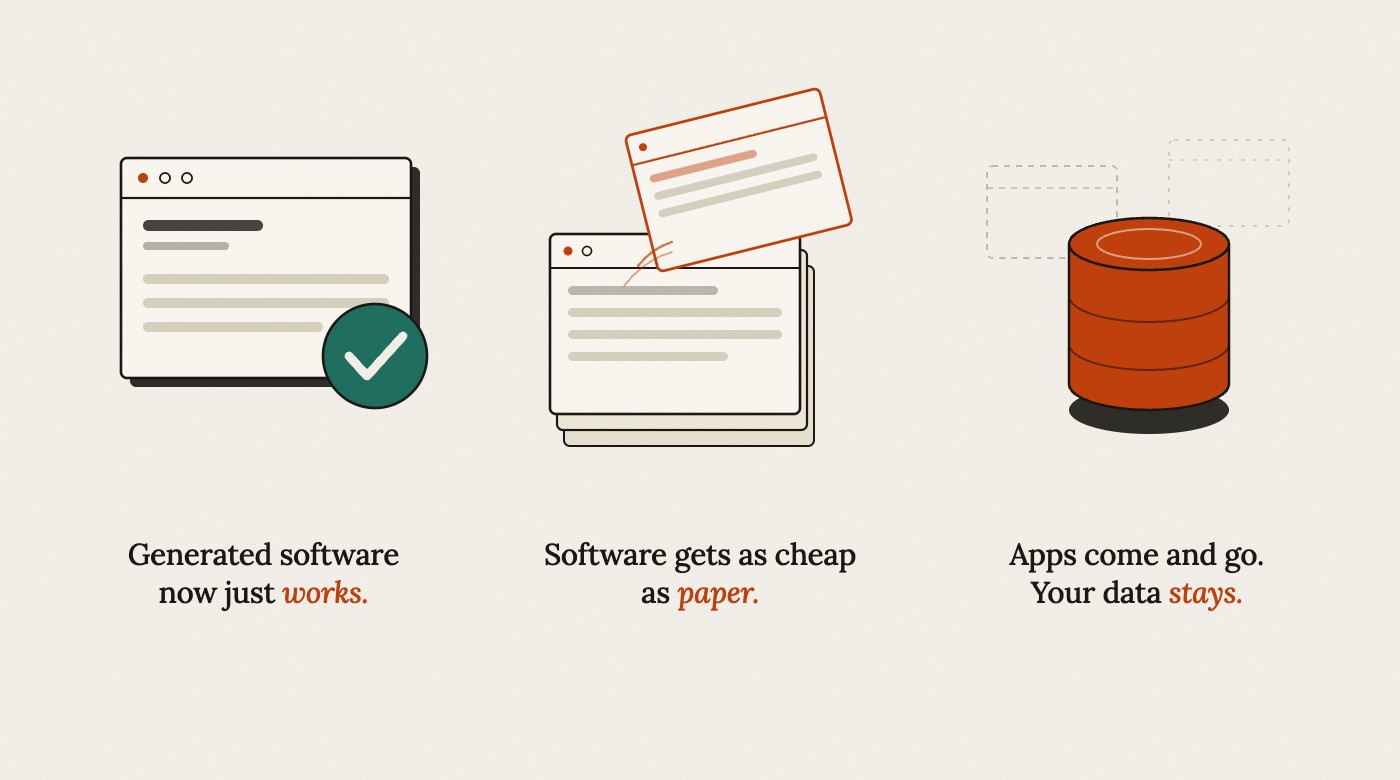
The first shift is reliability. Software generation with agents used to be a party trick — impressive demos, unshippable results. That has changed: agents plan, write, test, and correct their own work well enough to produce software you can actually use. And once generation is dependable, it doesn't have to stop at one-size-fits-all. The same pipeline that could build a generic app can just as easily build your version of it — matched to your content, your workflow, your level.
The second shift is cost. Generation is getting faster and cheaper at a rate traditional development never managed, and that changes what software is. When an app costs months and a team, you amortize it across a million identical users. When it costs minutes and cents, software becomes use-and-throw: generate the tool the moment you need it, keep it while it earns its place, discard it without ceremony when you're done. Disposability isn't waste — it's what makes true customization affordable.
The third shift is where the value lives: your data. The apps can morph and be thrown away precisely because they were never the important part — your documents, your history, your preferences are. That context lives outside any single piece of software, and it's what powers hyper-customization: every generated app starts already knowing who you are and what you're working on, instead of starting from zero.
The four products
A thesis is only worth as much as the software it produces, so we're proving this one on four surfaces at once. Each product below takes the same machinery — reliable generation, throwaway interfaces, portable context — and points it at a different part of life: learning, running a business, building software, and telling stories. One is free to try today; the other three are in private beta.
Osmova — any content, working software and a path to master it. Upload a document or drop in a topic; a multi-agent pipeline reads it, builds interactive apps that match the content, and lays out a personalized learning path that adapts as you go. Osmova is free to try today at osmova.ai.
Vibe Weaver — apps that don't exist until you ask. An app platform for small and medium businesses: describe what you need in plain language and the app appears; reshape it the same way. In private beta at vibeweaver.ai.
Auto Loop — builder loops for Claude Code. Keep agents building while you step away: starting runs, watching them land, feeding in the next task so an agent can work a backlog end to end. In private beta at autoloop.sh.
Vibe Comics — any story or idea, a true-to-source comic. Hand it a story, a script, or a rough draft and it breaks it into panels, keeps characters and plot faithful to the source, and draws a comic you can read and share. In private beta at vibecomics.io.
One idea underneath
Each product is the same four pieces pointed at a different surface: agents that persist and pick up skills, context that outlives any single app, interfaces that are generated and disposable, and loops that keep working when you step away.
If that resonates, try Osmova — or join the waitlist on the home page and we'll open the door to the other three as they're ready.